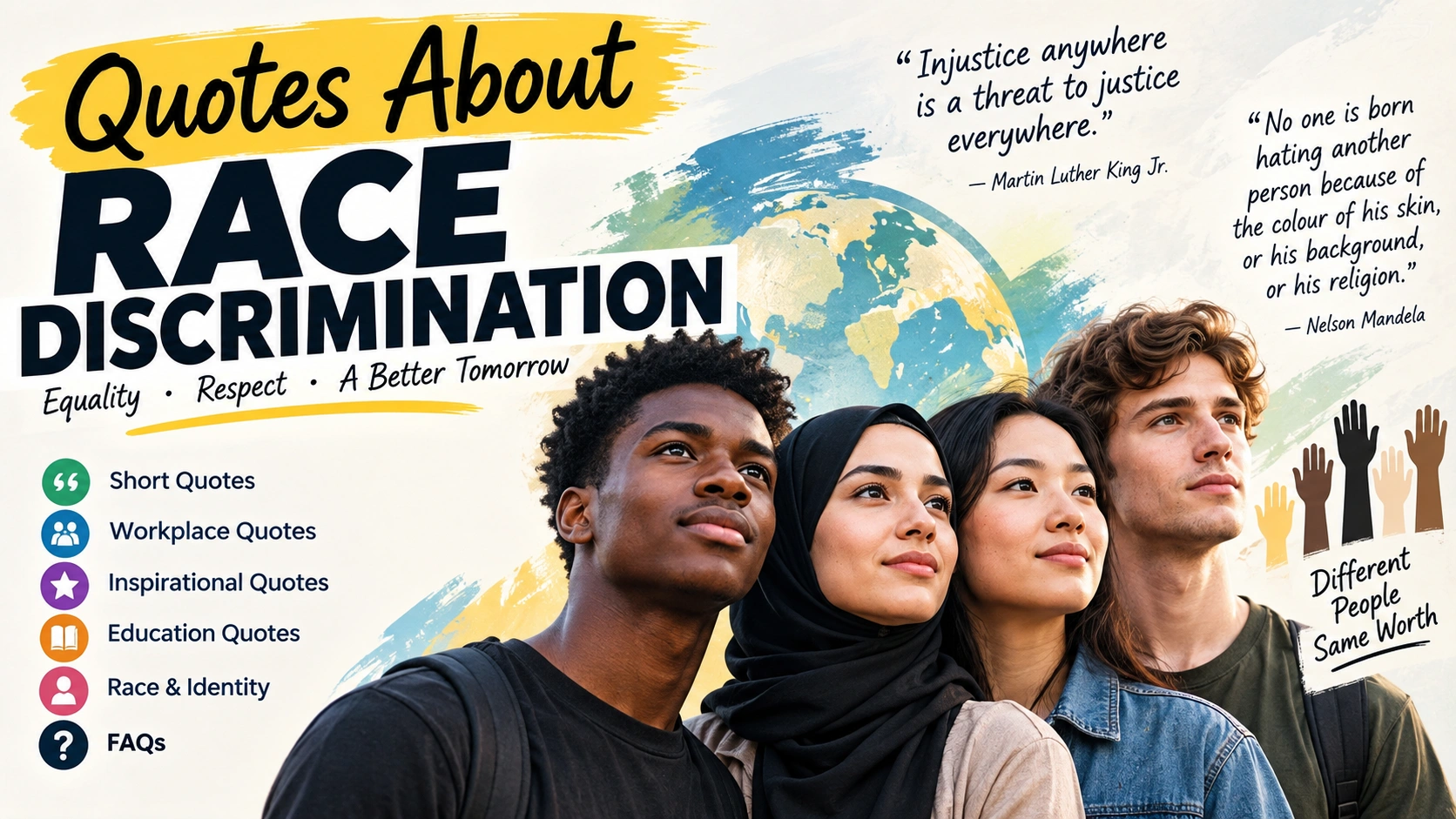
Words can give people language for experiences that are difficult to explain. Quotes about race discrimination can help readers reflect on prejudice, inequality, racial injustice, identity, and the responsibility to treat people with dignity. They are often used in school assignments, workplace discussions, speeches, social media captions, presentations, and personal reflection.
The most useful quotations do more than sound powerful. They connect discrimination with equality, human rights, empathy, courage, and action. Below is a carefully organized collection of short, inspirational, workplace, and education-focused quotes, along with guidance on choosing the right words for different situations.
Powerful short quotes
- “Injustice anywhere is a threat to justice everywhere.” — Martin Luther King Jr.
- “Darkness cannot drive out darkness: only light can do that.” — Martin Luther King Jr.
- “Hate cannot drive out hate: only love can do that.” — Martin Luther King Jr.
- “I hate the practice of race discrimination.” — Nelson Mandela
- “Racism must be opposed by all the means that humanity has at its disposal.” — Nelson Mandela
- “No one is born hating another person because of the colour of his skin, or his background, or his religion.” — Nelson Mandela
For an original caption rather than a quotation from a public figure, you can also use: “Different backgrounds should never determine different levels of human worth.”
Short anti-racism messages for social media
Social media posts usually benefit from language that is direct rather than academic. A message such as “Judge character, not complexion” is brief enough for a graphic, while “Equality begins when prejudice stops deciding who belongs” works better as a caption.
For a school or awareness post, a slightly more explanatory line can make the message clearer: “Racial discrimination divides people by identity; fairness recognizes their equal dignity.”
When posting a famous quotation on Instagram, Facebook, TikTok, Snapchat, or another platform, include the speaker’s name only when you are confident the attribution is correct. Popular quote websites sometimes repeat incorrectly attributed sayings, so checking a reliable original source is always preferable.
Quotes about race discrimination in the workplace
Racial discrimination at work can appear in hiring, promotion, pay, assignments, workplace treatment, professional opportunities, or assumptions about a person’s abilities. A quotation can open a conversation about fairness, but workplace communication should also remain specific and constructive.
Quotes for workplace equality
- “Injustice anywhere is a threat to justice everywhere.” — Martin Luther King Jr.
- “The problem of racial injustice is so weighty in detail and broad in extent that it requires the concerted efforts of numerous individuals and institutions.” — Martin Luther King Jr.
- “I have fought against white domination and I have fought against black domination.” — Nelson Mandela
- “I have cherished the ideal of a democratic and free society in which all persons live together in harmony and with equal opportunities.” — Nelson Mandela
These quotations can be appropriate for diversity training, employee-resource-group materials, leadership presentations, or workplace awareness campaigns.
However, a quote should support the discussion rather than replace practical action. If an organization is addressing a complaint, for example, a clear description of what happened is more useful than an inspirational statement alone.
Using a quote professionally
A workplace presentation might introduce a quotation with a sentence explaining its relevance: “Equal opportunity requires more than a written policy; it requires fair treatment in everyday decisions.”
You can then discuss recruitment, promotion, teamwork, management practices, and respectful communication.
For an internal email or formal complaint, avoid using dramatic quotations as a substitute for evidence. Explain the behavior, date, context, people involved, and impact as accurately as possible. Quotes are most effective when they encourage reflection, while specific facts help organizations understand and respond to a problem.
Inspirational quotes about race discrimination
Inspirational quotations about racial injustice often focus on courage, equality, solidarity, and the possibility of change. The strongest examples do not suggest that discrimination disappears simply because people think positively. Instead, they encourage people to challenge prejudice and support fair treatment.
Quotes about equality and courage
- “Darkness cannot drive out darkness: only light can do that.” — Martin Luther King Jr.
- “Hate cannot drive out hate: only love can do that.” — Martin Luther King Jr.
- “No one is born hating another person because of the colour of his skin, or his background, or his religion.” — Nelson Mandela
- “People must learn to hate, and if they can learn to hate, they can be taught to love.” — Nelson Mandela
- “Racism must be opposed by all the means that humanity has at its disposal.” — Nelson Mandela
These words remain meaningful because they connect personal attitudes with wider social conditions. Prejudice can influence how people perceive others, while discrimination can turn those attitudes into unequal treatment.
Inspirational language becomes most meaningful when it encourages empathy as well as responsible action.
When an inspirational quote is appropriate
Use an inspirational quotation when your goal is encouragement, reflection, or awareness. It can work well at the beginning or end of a speech, on an educational poster, in a classroom presentation, or as part of an anti-racism campaign.
For a serious academic paper, however, a quotation should be accompanied by analysis. Explain who said it, what circumstances shaped the statement, and how it relates to your argument. That approach demonstrates understanding rather than simply collecting memorable lines.
Quotes about race discrimination in education
Schools and universities are important settings for conversations about racial equality because education shapes how people understand history, identity, culture, and difference. Quotes can help students introduce topics such as prejudice, inclusion, equal opportunity, respect, and racial inequality.
Quotes for students and teachers
- “Injustice anywhere is a threat to justice everywhere.” — Martin Luther King Jr.
- “The racial issue that we confront in America is not a sectional but a national problem.” — Martin Luther King Jr.
- “No one is born hating another person because of the colour of his skin, or his background, or his religion.” — Nelson Mandela
- “Racism must be opposed by all the means that humanity has at its disposal.” — Nelson Mandela
For students, the best quotation depends on the assignment. A history essay may need a quote connected to a specific event, while a classroom speech may benefit from a concise statement about equality.
A poster usually needs fewer words, whereas an essay can explore the historical meaning behind the quotation.
How to use a quote in a school assignment
Do not place a quotation on the page without explaining it. A simple three-step approach works well:
- Introduce it: Identify the speaker and the subject being discussed.
- Quote it: Use only the portion that directly supports your point.
- Explain it: Connect the words to racial discrimination, equality, historical events, or your argument.
For example, after using King’s statement that injustice anywhere threatens justice everywhere, a student could explain how discrimination affects not only individuals but also communities and institutions.
Quotes about race and identity
Race and identity are related but not identical concepts. Identity can include culture, family history, nationality, language, community, personal experiences, and many other dimensions.
Quotes about race should therefore be used thoughtfully rather than reducing a person’s entire identity to skin color or ethnicity.
Words that encourage respect and belonging
Nelson Mandela’s statement about people not being born to hate others because of their skin color, background, or religion is useful when discussing how prejudice can be learned and challenged.
Martin Luther King Jr.’s writings also connect racial justice with human dignity, equality, and the responsibility to challenge unfair treatment.
For original writing, consider lines such as:
- “Identity should be understood, not used as a reason to exclude.”
- “Respect begins when we stop treating difference as a measure of worth.”
- “A person’s background can shape their story, but it should never determine their worth.”
- “Equality means recognizing dignity in every person.”
These are original statements and should not be attributed to historical figures.
Choosing respectful language
Language matters when writing about race. Avoid stereotypes, insulting labels, or broad statements about what an entire racial or ethnic group supposedly thinks or does.
Prefer precise terms such as racial prejudice, racial discrimination, racism, racial inequality, or racial bias when they accurately describe the subject.
It is also useful to distinguish between an individual’s prejudice and discrimination that operates through an organization or system. This makes an essay, presentation, or social-media post more precise and prevents different concepts from being treated as interchangeable.
How to choose the right quote for your message
The most effective quotation depends on what you want the reader to feel or understand. A short social-media caption needs clarity, while an academic assignment requires context and attribution.
| Purpose | Best type of quote | Main focus |
|---|---|---|
| Social media | Short and memorable | Equality and respect |
| School presentation | Historical or inspirational | Context and meaning |
| Workplace training | Professional and constructive | Fairness and opportunity |
| Essay | Documented historical quotation | Evidence and analysis |
| Poster | Brief statement | Clarity and awareness |
Before publishing a quote, ask three questions:
- Is the attribution reliable?
- Does the quotation actually support my message?
- Is the wording appropriate for the audience?
These simple checks can prevent a meaningful subject from being weakened by a misleading or incorrectly attributed quotation.
Frequently asked questions about race discrimination quotes
What is a famous quote about racism?
One widely cited quotation is Martin Luther King Jr.’s “Injustice anywhere is a threat to justice everywhere.” Another well-known quotation is Nelson Mandela’s statement that “No one is born hating another person because of the colour of his skin, or his background, or his religion.”
Both quotations can be useful when discussing prejudice, equality, racial injustice, and social responsibility.
What is racial discrimination?
Racial discrimination generally refers to unfair or unequal treatment based on race, color, ethnicity, or related racial characteristics.
It can occur in areas such as employment, education, housing, public services, and everyday social interactions. Racism is a broader term that can include prejudice, discriminatory behavior, and systems or practices that contribute to racial inequality.
What is a famous slogan about racism?
“Black Lives Matter” is one of the most widely recognized modern slogans associated with opposition to racial injustice.
Other anti-racism messages focus on equality, dignity, solidarity, and rejecting prejudice. When choosing a slogan, consider whether your audience needs a historical reference, a call to action, or a simple statement of equality.
What is a good quote for an anti-racism poster?
A short statement is usually strongest on a poster. Martin Luther King Jr.’s “Darkness cannot drive out darkness: only light can do that” is concise and focuses on responding to injustice without reproducing hatred.
An original alternative is: “Equality is not sameness; it is equal dignity and opportunity.”
What is a famous quote about racism?
“Injustice anywhere is a threat to justice everywhere.” — Martin Luther King Jr.
What are some famous quotes about discrimination?
“Darkness cannot drive out darkness: only light can do that.” — Martin Luther King Jr.
What is racial discrimination?
Racial discrimination means treating someone unfairly because of their race, skin color, ethnicity, or racial background.
Conclusion
Quotes about race discrimination are most powerful when they lead to understanding rather than simply collecting impressive words. Whether you are writing a school assignment, preparing a workplace presentation, creating a social-media post, or designing an awareness poster, choose language that respects people’s identities and clearly communicates the principle of equal dignity.
Verified quotations from figures such as Martin Luther King Jr. and Nelson Mandela can provide historical perspective, while original statements can give your message a distinct voice.
Quotes about race discrimination can give people powerful words to express ideas about equality, dignity, fairness, and respect. Whether you need a short quote for social media, an inspirational message for a poster, or a meaningful statement for a school or workplace presentation, the best choice is one that matches your purpose and audience.
Famous words from figures such as Martin Luther King Jr. and Nelson Mandela can also provide historical perspective. However, a quotation becomes more meaningful when it is followed by thoughtful reflection and action. Challenging prejudice, treating people fairly, and respecting differences are practical ways to turn messages about equality into everyday behavior.