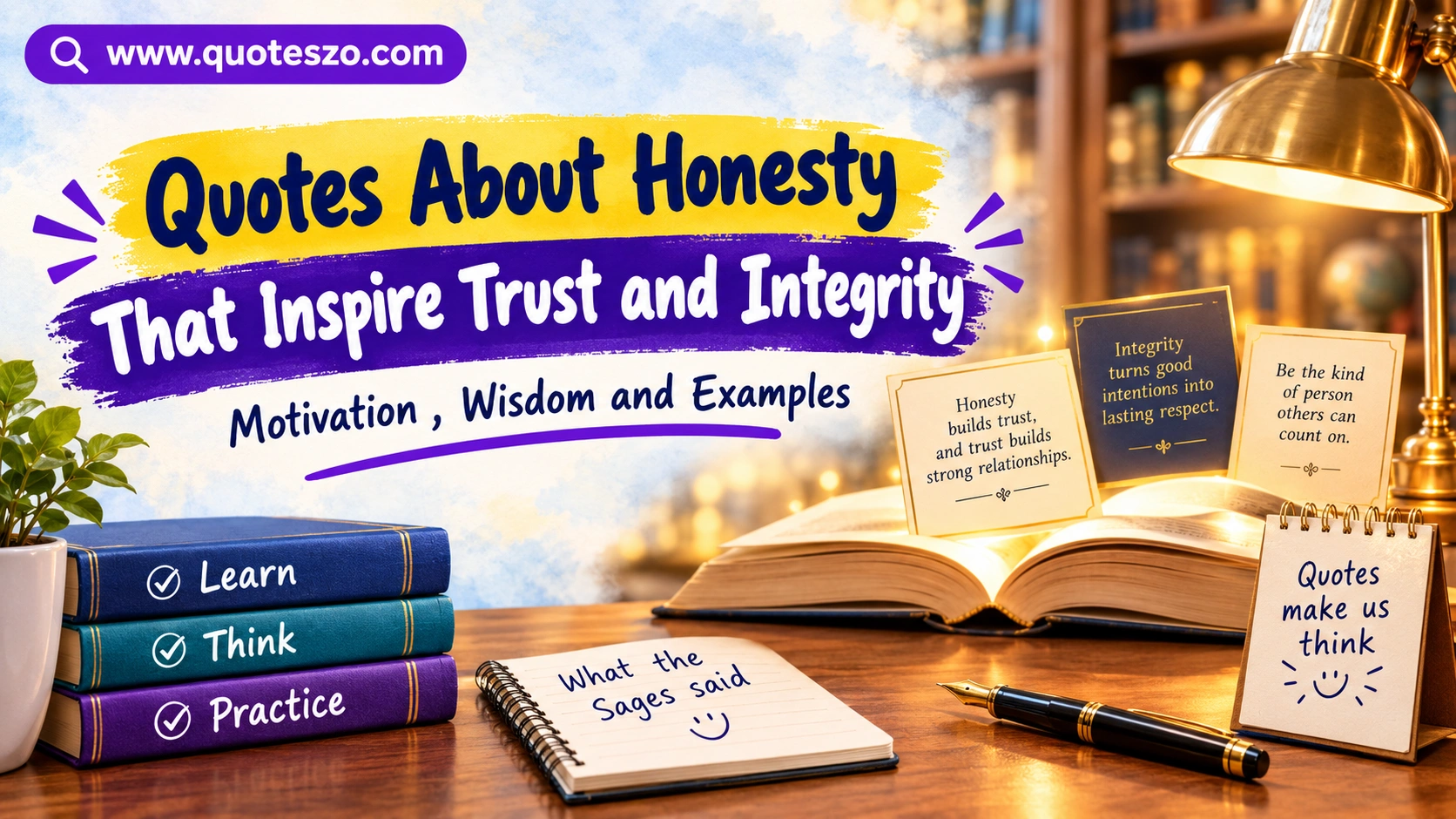
Honesty is more than simply telling the truth. It means communicating sincerely, admitting mistakes, keeping promises, and choosing integrity even when being truthful feels uncomfortable. Quotes about honesty can help express these ideas in a simple way, whether you need words for a classroom, relationship, social media post, personal reflection, or everyday conversation.
The best messages about honesty are not necessarily complicated. A short sentence can remind someone that trust grows through truthful actions and that character is often revealed when nobody is watching. The following collection brings together practical, original honesty quotes for different situations, along with explanations of their meaning and ways to use them.
Short quotes about honesty
Short quotes about honesty are useful when you want a clear message without a long explanation. They can work well as captions, journal reminders, classroom messages, greeting-card text, or simple responses during meaningful conversations.
Simple honesty quotes
- “Honesty makes trust possible.”
- “Truth gives character a strong foundation.”
- “Be honest, even when it is difficult.”
- “A truthful heart needs no complicated story.”
- “Honesty turns words into something people can trust.”
- “Truth may be uncomfortable, but deception costs more.”
- “Speak truth with courage and kindness.”
- “Honesty begins where excuses end.”
- “A clear conscience is worth protecting.”
- “Truthful words build lasting respect.”
- “Honesty is character in everyday action.”
- “Trust grows where honesty is practiced.”
- “Tell the truth, then stand by it.”
- “Honesty gives relationships room to breathe.”
- “A sincere answer is better than a convenient lie.”
How to use short honesty quotes
A short quote works best when its message matches the situation. For example, “Speak truth with courage and kindness” could accompany a post about giving honest feedback without being harsh. “Honesty makes trust possible” may suit a message about friendship, teamwork, or relationships.
For social media, shorter wording is generally easier to read. On Instagram or Snapchat, a concise line can work as a caption over a simple image. In a classroom, an honesty quote can introduce a discussion about academic integrity, responsibility, or telling the truth.
Top 10 honesty quotes
The following ten messages focus on different sides of honesty, including truthfulness, trust, responsibility, courage, and integrity. They are written as original, publication-ready sayings rather than presented as quotations from famous people.
1. “Honesty makes trust possible.”
Trust cannot develop when people constantly have to question whether they are receiving the truth. Honest communication gives relationships a dependable starting point.
2. “Truth may be uncomfortable, but deception costs more.”
Telling the truth can create a difficult conversation, especially after a mistake. Hiding the problem, however, can create additional confusion when the truth eventually comes out.
3. “Speak truth with courage and kindness.”
Honesty does not require cruelty. Someone can be truthful while still considering another person’s feelings, dignity, and circumstances.
4. “A truthful heart needs no complicated story.”
When people consistently tell the truth, they do not need to remember different versions of events. Simplicity and consistency can make communication clearer.
5. “Honesty is character in everyday action.”
Character is not demonstrated only through major decisions. Returning something that does not belong to you, admitting an error, or correcting misinformation can all demonstrate honesty.
6. “Trust grows where honesty is practiced.”
Trust is usually strengthened through repeated behavior rather than one impressive statement. Small truthful actions can matter in friendships, families, classrooms, and workplaces.
7. “A sincere answer is better than a convenient lie.”
Sometimes people lie because the truth seems awkward or inconvenient. A sincere response may be harder initially, but it allows the other person to make decisions using accurate information.
8. “Honesty begins where excuses end.”
Taking responsibility requires more than explaining why something happened. A person who acknowledges their role can begin looking for a practical solution.
9. “Tell the truth, then stand by it.”
Honesty includes consistency. If you give truthful information, accepting the consequences of that answer is part of acting with integrity.
10. “Truthful words build lasting respect.”
People may disagree with an honest opinion, but straightforward communication gives them a clearer basis for understanding your position.
Quotes about honesty and integrity
Honesty and integrity are closely connected, but they are not exactly the same. Honesty generally concerns truthfulness and avoiding deception. Integrity is broader: it involves acting according to sound principles and maintaining consistency between what you say and what you do.
Meaningful messages about character
- “Integrity keeps your actions aligned with your words.”
- “Honesty tells the truth; integrity lives by it.”
- “Strong character appears in choices made without an audience.”
- “Integrity is choosing what is right over what is convenient.”
- “A trustworthy character is built through truthful habits.”
- “Honest words have greater meaning when honest actions follow.”
- “Character becomes visible when nobody is there to applaud.”
- “Integrity gives honesty a place in everyday behavior.”
- “Doing the right thing consistently creates dependable character.”
- “A person of integrity does not need a different standard for every situation.”
Honesty versus integrity
| Honesty | Integrity |
|---|---|
| Focuses strongly on truthfulness | Covers broader principles and conduct |
| Includes avoiding lies and deception | Includes keeping commitments and acting consistently |
| Appears in communication | Appears in both words and actions |
| Helps establish trust | Helps maintain trust over time |
Consider a student who accidentally receives extra marks on an exam. Telling the teacher about the error demonstrates honesty. Returning to the same standard when nobody is watching demonstrates integrity. The two qualities often support each other.
Famous quotes about honesty
People often search for famous quotes about honesty because well-known sayings can communicate a familiar idea in a memorable form. However, quotations attributed to historical figures should be checked against reliable sources before being presented as authentic.
Why attribution matters
Online quote collections sometimes attach popular sayings to famous writers, philosophers, leaders, or celebrities without clear evidence. A quotation that sounds appropriate for a particular person is not automatically something that person said.
For a trustworthy article, avoid presenting an uncertain attribution as fact. If you are using a famous quotation in a school assignment, presentation, article, or social media graphic, verify the wording and source first.
Themes commonly found in famous honesty quotations
Many well-known sayings about honesty explore ideas such as:
- Truth and trust
- Personal responsibility
- Moral courage
- Reputation and character
- The consequences of deception
- The relationship between words and actions
A useful approach is to focus on the idea behind a quotation rather than simply collecting famous names. A message about truth becomes more meaningful when readers can understand how it applies to an actual situation.
For example, an honesty quote about admitting mistakes can be connected to a student correcting an assignment, an employee acknowledging an error, or a friend apologizing after giving incorrect information. Context turns a memorable sentence into a practical lesson.
Honesty quotes for students
Students encounter many situations in which honesty matters: completing assignments, taking tests, working in groups, acknowledging mistakes, and communicating with teachers and classmates. Quotes about honesty can provide simple language for discussing academic responsibility and personal character.
Encouraging messages for school
- “Honest work is something you can be proud of.”
- “Your character matters as much as your grades.”
- “Admitting a mistake is part of learning.”
- “Truthful effort builds confidence from the inside.”
- “Do your own work and let your progress speak.”
- “Honesty turns mistakes into opportunities to improve.”
- “A truthful answer is better than a perfect excuse.”
- “Learning includes having the courage to say, ‘I was wrong.’”
- “Good character travels with you beyond the classroom.”
- “Success means more when you earn it honestly.”
A real classroom example
Imagine a student notices that a teacher accidentally gave them more marks than they earned. The easiest choice might be to remain silent. An honest response would be to point out the mistake.
That decision may feel uncomfortable, particularly if the student worries about losing marks. Yet the situation provides an opportunity to practice responsibility rather than simply discuss it. An appropriate response could be:
“I think there may be an error in my marks. Could you please check question four?”
The wording is simple, respectful, and honest. It does not accuse the teacher or make the situation unnecessarily dramatic.
Honesty in group work
Academic honesty also matters when students work together. Sharing ideas can be useful, but presenting another student’s work as your own is different. Clear communication about contributions helps everyone understand what each person completed.
Honesty quotes for relationships
Honesty plays an important role in friendships, family relationships, and romantic partnerships because people need reliable information to make decisions and understand one another.
Words about trust and openness
- “Honesty gives love a foundation of trust.”
- “A strong relationship leaves room for difficult truths.”
- “Tell the truth without turning honesty into cruelty.”
- “Trust grows when words and actions agree.”
- “Honest conversations can prevent silent misunderstandings.”
- “Respect means giving people the truth they need to understand.”
- “A healthy conversation allows both people to speak honestly.”
- “Honesty does not remove every disagreement; it makes disagreement clearer.”
- “Real trust leaves space for sincere answers.”
- “Truthful communication gives relationships a chance to grow.”
Honesty does not mean being harsh
There is a difference between honesty and saying whatever comes to mind without considering another person’s feelings. A truthful statement can still be respectful.
Suppose a friend asks, “What do you think about my presentation?” Saying “It was terrible” may be honest about your reaction, but it provides little useful guidance. A more constructive response might be:
“I liked the main idea, but I think the introduction could be clearer and the ending could be stronger.”
The second response communicates a genuine opinion while giving the other person something useful to work with. Honesty becomes more constructive when it is combined with respect.
When honesty is especially important
Open communication can be particularly valuable when discussing misunderstandings, expectations, boundaries, mistakes, and important decisions. Avoiding a difficult conversation may feel easier temporarily, but unclear communication can leave both people making assumptions.
Honesty also means recognizing what you do not know. Saying “I don’t know the full story, so I don’t want to assume” is often more truthful than confidently repeating information you have not verified.
Frequently asked questions about honesty
What is a good quote about honesty?
A simple original quote is: “Honesty makes trust possible.” It expresses the connection between truthful communication and dependable relationships in only a few words.
What is a famous quote about honesty?
There are many widely circulated quotations about honesty, but attribution should be verified before a saying is credited to a famous person. Online quote collections can contain incorrectly attributed or altered quotations.
Why is honesty important in life?
Honesty helps people communicate accurate information, accept responsibility, and make decisions based on reality rather than deception. It can also contribute to trust in personal, academic, and professional relationships.
What is a good honesty quote for students?
“Admitting a mistake is part of learning” is suitable for students because it connects truthfulness with personal improvement rather than treating mistakes as something to hide.
What is the difference between honesty and integrity?
Honesty primarily concerns truthfulness and avoiding deception. Integrity is broader and includes acting consistently with your principles, keeping commitments, and doing the right thing even when there is no audience.
How can I use honesty quotes on social media?
Short honesty quotes can work as Instagram captions, TikTok text overlays, Snapchat posts, Facebook updates, or messages. Choose a line that matches the situation rather than adding a quote simply to fill space.
Can honesty hurt someone’s feelings?
Yes. Truthful information can sometimes be difficult to hear. However, honesty does not require unnecessary harshness. A person can communicate the truth respectfully, explain their perspective, and consider the other person’s feelings.
How can children learn about honesty?
Children can learn through consistent examples, age-appropriate conversations, stories, and opportunities to take responsibility for mistakes. Praising truthful behavior can also reinforce the idea that admitting an error is safer and more constructive than hiding it.
Honesty is ultimately practiced through ordinary decisions. It appears when someone admits a mistake, gives accurate information, returns something that is not theirs, keeps a promise, or speaks sincerely during a difficult conversation. Quotes can remind us of these principles, but their real value comes from applying them.
The strongest message about honesty is therefore not just something that sounds good on a page. It is a principle that can guide behavior when the easier option would be to hide, exaggerate, or avoid the truth. Whether used by a student, friend, parent, teacher, or professional, a thoughtful reminder about honesty can encourage clearer communication and stronger character.